
By: Allison Fine
The Social Media Academy supported by The AVI CHAI Foundation recently concluded its first pilot effort. Micah Sifry and I wrote a report reflecting on the process and immediate results of the Academy. The full report can be accessed on the Foundation’s website here.
I’ve written about the process and participants before here. In short, the Academy ran for six months and included three in-person workshops, individual coaching, online support and sharing, and at least one social media experiment conducted by each group.
The participating schools were:
Davis Renov Stahler (DRS) Yeshiva High School for Boys (HALB)
Mesivta Ateres Yaakov
Rae Kushner Yeshiva High School
SAR High School
Solomon Schechter School of Westchester
SSDS of Nassau County and SSHS of Long Island
Stella K. Abraham High School for Girls
Westchester Hebrew High School
Yeshiva University High School for Boys
Yeshiva University High School for Girls
Yeshivas Ohr Yosef
The lead trainer for the Academy was Lisa Colton of Darim Online. The coaches were from Big Duck.
Lessons Learned
Based on written feedback and interviews with the participants and coaches, plus our own observations, we learned:
Participants were ready and eager to learn from one another on land and online.
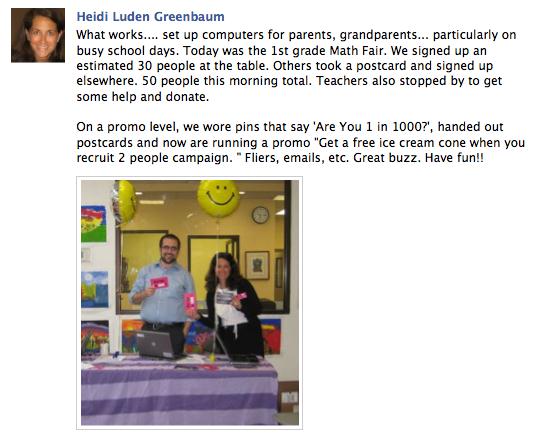
This was particularly relevant during the Causes campaign. Here is an example of Heidi Greenbaum sharing a lesson of SAR’s success reaching out during the school day for the fundraising campaign:
Day school culture is just starting to find its social media comfort level. As one participant said, “We complete this academy with a bigger picture, one that will allow us to recognize the need for social media, yet allow it to fit into the context of the morals of our yeshiva.”
School staffs are stretched. All of the schools have staffs stretched to the breaking point. Even staffs of larger schools wear multiple hats and work within systems and cultures with little time for planning and reflection. This creates cultures within the schools of being reactive, always on the edge of crisis financially and programmatically, always running behind because of the rigors of running schools with so little infrastructure.
The size of the school is not a determining factor of success. One very small school did very well in the Academy. They increased their list of alumni significantly, did very well in the Causes fundraiser, created a lively Facebook page, and, perhaps most importantly, stretched their willingness to take risks publicly. There was uneven success among the larger schools based on whether their internal cultures could transition from a broadcast model to a conversational modes.
Schools need to focus first on culture change, then tools. Most of the coaching time was spent discussing ways to overcome organizational apprehension of social media, as opposed to particular social media tools or tactics. This was neither surprising nor detrimental. Academy participants learned to develop strategies for engaging heads of schools, and evolved policies for addressing the fears of taking the walls down even further. One participant recalled, “Knowing full well that the success of such a venture would require the backing of our educational institution’s administrative personnel, our immediate focus turned from content development to strategic planning.” From the plans and strategies the schools developed, they were then able to focus on which social media channels were best suited to their needs. LinkedIn and Twitter were particularly popular tools, along with the schools’ own websites and email.
Staff turnover is endemic in day schools. Turnover of administrative staff is a constant activity in the schools. It is inevitable that some participants will leave during or immediately after an effort like this. We can invite more participants from schools to the Academy; however, this is simply a part of life with day schools, and the best defense against the turnover is to make sure schools create social media policies, insist that plans are written and shared, and hire new staff conversant and comfortable with social media who can help move this agenda forward.
Alumni and parents are ready to use social media. Schools found their alumni, in particular, were hungry for an organized connection. Several schools used a fun method for engaging alumni by posting old class pictures and asking them to tag their classmates. It was easy, communal and a different engagement than a request for $25 to the endowment fund. One participant found that his students were having fun using Twitter, and by joining in with them he was reminded what it felt like to be playful. As he told us, “This program made me see things in a different way. I had 50 followers on Twitter in March. I now have 202.” He is also in the process of incorporating the use of social media into his curricula.
The “Aha!s”
Some of the “Aha!s” included:
- Using Twitter on a class trip to Washington, DC to find that a large number of parents followed her and participated in the conversation on Twitter about the trip.
- Reporting feeling empowered and knowledgeable enough to talk to peers about the pros and cons of Facebook.
- Realizing that using social media did not reduce or replace the need for face-to-face interactions.
- Understanding integrated communications, the idea that your Facebook Page supports all the things you’re doing on your website, in your emails, and in your communications generally.
- Re-learning how to speak to individuals and groups in natural, conversational ways. One participant said, “The conversation has to be meaningful and sticky – to them! No one listens unless we’re sharing and engaging. We have to be real, have to have a personality.”
We hope you will have a chance to read the entire report. Our lasting impression is that every participant, it seemed, had his or her own unique experience during the Academy. Here are two of my favorite reflections about the need for people and organizations to intentionally make themselves uncomfortable in order to change their organizational culture:
“Many of us had to come out of our comfort zones to face that social media plays an important role in our work lives and figure out a way to use it all effectively.” -Dina Yakar, Solomon Schechter of Long Island
“We began this academy with some reservation about reaching out to our students via social media, but we complete this academy with a bigger picture, one that will allow us to recognize the need for social media, yet allow it to fit into the context of the morals of our yeshiva.” -Elly Storch and Jeff Rothman, HALB/SKA/DRS